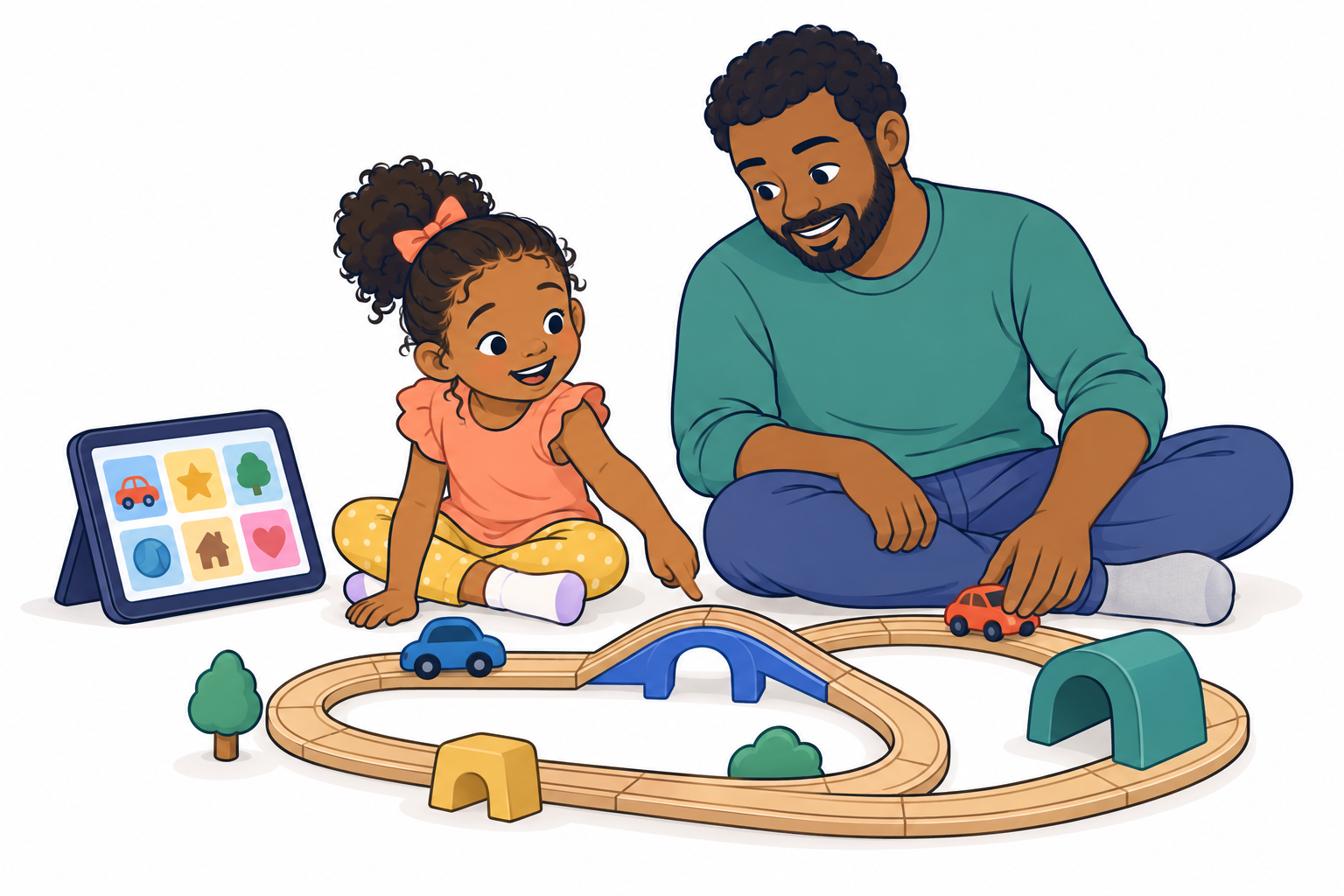
Practical caregiver actions for shared play and activities you introduce, with clear examples of building on sounds, words and sentences.
If you read one thing
Notice what interests your child. Say or show a word or short phrase that fits, then pause. If your child responds, follow their idea. If they stay quiet, you can keep playing or finish.
If a message or need is already clear, respond now. These are flexible caregiver actions; you can start with just one.
These are five caregiver actions, not five tasks for your child. If they already have a message, respond straight away. Respond and Build may happen in the same reply; you do not need to complete every step.
See it in an everyday moment
Join play or introduce an activity. Choose a step to read at your pace, or play the illustrated sequence.
A car on the track. Step 1: Notice.
Illustrated example · A car on the track
Notice
STEP 1 OF 5
Notice
Find a shared starting point
Notice the car they are moving and whether joining is welcome. Stay alongside their play with your own car.
You could say“Your car is going.”
Notice what happened before a look, sound or movement. Check uncertain meaning; eye contact is not required.
The example moves from step to step so you can read it. Pause it whenever you like. With your child, take as much time as they need for their turn.
Respond to needs now. Help, breaks and familiar communication tools stay available. Skip a step, repeat, simplify or finish when that fits.
Read this example from start to finish
Your child is playing with a car. You bring a second car nearby without taking theirs.
1. Notice
Notice the car they are moving and whether joining is welcome. Stay alongside their play with your own car.
You could say: Your car is going.
Notice what happened before a look, sound or movement. Check uncertain meaning; eye contact is not required.
2. Model
Move your own car and show a useful message. Say it naturally and model a familiar sign or AAC symbol if helpful.
You could say: Go! The car is going.
A model gives an example. It does not ask for a spoken copy or a particular gesture.
3. Pause
Become quiet and leave space for a contribution while play and communication tools stay available.
Keep in mind: Give their turn room.
Allow time for a movement or AAC message to finish. There is no compulsory countdown; respond sooner to a need or message.
4. Respond
Your child says ‘car’ or selects CAR on their familiar system while moving it. Acknowledge the car and share the action.
You could say: Yes, the car!
Their message already counts. You can respond without asking for more words.
5. Build
Build on ‘car’ with an action in a short natural sentence. Continue moving your own car alongside theirs.
You could say: The car goes.
This is an expansion of their message. You may model familiar CAR + GO through an agreed AAC arrangement; never take over their message. No repeat is required.
THE CAREGIVER'S PART
What to do at each step
Open a step for practical instructions and an example. You can learn one action at a time.
1NoticeFind a shared starting point
Join an interest or introduce an activity. Notice comfort, attention and what your child may be communicating.
Choose safe, age-respectful materials. Position yourself where your face, hands and communication tools are easy to see if useful; beside them may work better than directly opposite. Do not move their head, require eye contact or change prescribed positioning. Keep hearing, vision and communication supports available.
Watch before adding a teaching turn. You may offer a toy, book or clear activity with a beginning and an end; notice how they respond.
Describe what you saw, then check a possible meaning. Reaching toward a book could mean help, another page or wanting it moved. Let their response change your interpretation; silence does not confirm your guess.
For example: They hand you a closed book. You say ‘Maybe you want it open’ and offer to open it, watching what they do next. If the meaning remains unclear, keep it as your interpretation rather than recording a confirmed request.
Keep in mind: Eye contact, pointing, speech and sitting still are not entry requirements. If a message or need is already clear, respond now.
Prompting in this step
Choose a useful focus only when teaching fits. Check access and willingness before deciding more help is needed.
2ModelShow a useful message
Name something your child notices with a word or short phrase. Use it again when it fits. You can speak, sign, gesture or use AAC, such as a picture board or communication app.
Try focused stimulation when your child is interested. Choose a word for a person, object, action or idea. Use it as you share that moment, then bring it back when the meaning comes up again. Words for help, refusal and enjoyment count too.
Use your family's languages and dialects. A short complete phrase, meaningful word or familiar sign may fit. How much a child says does not tell you everything they understand.
Try a comment before another quiz question. While the car rolls, ‘That car is fast’ supplies a model without asking for an answer. A genuine question about their choice or idea can still fit; there is no required comment-to-question ratio.
Children learning AAC need chances to see other people use it, including before they use a symbol themselves. Pick a familiar message that fits your own action, such as GO as your car moves or FUN when you enjoy it. Speak naturally and model a key symbol through the agreed access arrangement or a partner board; you need not select a symbol for every spoken word.
Leave their full AAC system available. Do not take their turn, change their composed message or guide their hand. Finish your model, then leave quiet room. If they communicate something else, follow that meaning; if nothing comes, keep the activity available and continue naturally. Model again in another welcome everyday moment, not in an uninterrupted stream.
For example: If your child notices a bus arriving, say ‘Here comes the bus!’ Leave room to watch it together. As it goes, you might wave and say ‘Bye, bus!’ If they turn to something else, follow their interest.
Keep in mind: Use your own actions. Do not move the child's hands or body to produce a message. Repeating a useful example is different from repeatedly asking them to perform.
Prompting in this step
Decide whether you are giving language input or a prompt for a particular response. Physical motor assistance needs a separate individualized plan.
Become quiet and allow time for a contribution. Watch for a turn without holding back help or an activity.
After your contribution, stop adding words and resist filling the quiet with another question. Stay available without staring. Watch for looking, reaching, selecting or composing, and let the child finish.
Notice the urge to ask again or fill the silence. If your child is comfortable, let that urge pass and leave a quiet turn. Finding a symbol, typing or preparing a movement may take longer than a spoken reply. Let an emerging message finish; respond sooner to a need or distress.
There is no required number of seconds. If nothing comes, that is still a complete moment. Continue gently, simplify, offer help or finish. A clear message, discomfort or urgent need takes priority over waiting.
For example: You comment on a picture, then become quiet while your child searches their AAC. Let them finish instead of adding another question.
Keep in mind: Keep needed items, play and communication tools available. A pause is an opening, not a condition the child must meet.
Prompting in this step
Leave enough time for the whole response. A planned prompt delay is individualized; it is never a reason to withhold help.
4RespondAcknowledge and act on the meaning
Show that you noticed the message, then respond to its purpose. Check unclear meaning and accept corrections.
Help with a difficulty, share a discovery, answer a question, follow an idea or stop an optional activity. A sound, gesture, sign or AAC message deserves a response too.
Treat your interpretation as a guess until the child's own response supports it. If yes/no is not reliable, two real, accessible options may help: show a ball and a book and offer ‘Ball or book?’ Use their familiar way to choose, with neither, stopping or another idea still possible. A look alone may not identify a choice. If there is no clear selection or correction, the meaning remains unconfirmed; silence is not agreement. Meet obvious needs rather than repeating the question or guiding a choice.
Name a clear request before explaining the limit: ‘You want bubbles. They are finished. We can draw or take a break.’ A warm acknowledgment shows you heard the message even when you cannot grant the request. It does not guarantee that your child will be content with the answer. Offer only real options, keep comfort and communication available, and allow disappointment. Do not make a clearer or longer message the condition for getting something that is actually available.
For example: They communicate ‘help’ while showing a stuck car. Begin helping and say ‘I'll help.’ Do not wait for ‘help me, please.’
Keep in mind: Respond first. A longer sentence, clearer sound, precise point or extra button press is never the price of help or a break.
Prompting in this step
Respond to the child's meaning, including a correction or refusal. Note the model or cue that came before a response.
5BuildExpand the message when it helps
Build on a meaningful sound, word, phrase or sentence with a brief fuller model. Signs, gestures and AAC can also give you an idea to build on.
Keep their meaning and topic. With a sound or unclear message, check the context first. If meaning is still uncertain, respond and clarify rather than inventing an expansion.
Start with one manageable addition that fits the idea: ‘car’ could become ‘red car’ for a red car or ‘car goes’ while it moves. This is a helpful starting point, not a word-count limit. Preserve natural grammar: ‘Dog run’ might become ‘The dog is running.’ A full sentence may need one useful detail, an answer or no expansion.
Use familiar signs or AAC when helpful without taking over their message. Leave space again and continue. Repeat, simplify or finish according to the moment; your child does not need to repeat your model.
For example: They say ‘car’ while it moves. You acknowledge it and say ‘Car goes.’ If they say ‘The car is stuck,’ help first; ‘It's stuck under the bridge’ can add a useful detail while helping.
Keep in mind: Longer is not always better. ‘One more word’ is a starting idea, not a rule. Keep natural grammar and your family's dialect; not every turn needs expanding.
Prompting in this step
Expand when useful. Across later opportunities, reduce extra reminders as they become unnecessary; keep needed AAC and access supports.
Keep their idea, offer a little more language and leave room. These are options, not levels to pass through. A familiar shorter model may be more useful than a longer one.
4 · Respond: acknowledge the message and act on its purpose.
5 · Build: offer a brief fuller model when it adds something useful.
A sound or word attempt
Your child communicates
‘Ba’ while holding up a ball.
Respond
Notice the ball together. You may say ‘Ball?’ as a tentative interpretation, but silence does not confirm it. Leave room for a different meaning.
Build, if useful
If the context supports ball: ‘Ball! A big ball.’ Otherwise comment on what you can see or leave space.
A context-based guess remains a guess without a clear response. ‘Big’ fits only if the ball is big. A playful sound with unclear meaning does not have to become a word.
A word
Your child communicates
‘Car’ while the car moves.
Respond
Notice the car together.
Build, if useful
‘Car goes.’ Or ‘red car,’ if that detail fits.
Add one manageable idea, not a required number of words. A short natural phrase can be enough; do not ask for a copy.
A phrase
Your child communicates
‘Dog run’ while a toy dog is running.
Respond
Join the idea about the running dog.
Build, if useful
‘The dog is running.’
Offer a model without telling them they are wrong. Use natural forms in your own language or dialect.
A sentence
Your child communicates
‘The car is stuck’ when it is caught under a bridge.
Respond
‘It's stuck. I'll help.’ Begin helping.
Build, if useful
‘It's stuck under the bridge.’
Add location if useful while helping. Sometimes an answer is enough; do not make every sentence longer.
A sign or AAC message
Your child communicates
Signs CAR or selects CAR on their familiar system as the car moves.
Respond
Acknowledge the car they mean.
Build, if useful
Say ‘The car is going.’ If appropriate, model familiar CAR + GO on a partner board or through their agreed access arrangement.
Their full system stays available. Do not edit their message or select symbols as if the child authored them.
A gesture
Your child communicates
Reaches toward a ball.
Respond
Offer ‘The ball?’ and respond to what they indicate.
Build, if useful
Once meaning is clear, ‘Here is the ball’ can accompany giving it.
A gesture can carry the whole message. No point or spoken word is required. Your model is not proof the child said the word.
A request to stop
Your child communicates
‘No,’ STOP on AAC, closing the book or another familiar stop signal.
Respond
Stop the optional activity and acknowledge the message.
Build, if useful
Finish here. No expansion is needed.
Help, safety, distress and breaks take priority over teaching a longer message.
Keep the child's meaning. Offer natural language. Leave space again. Their original message is enough; repeating your model is optional.
Make it fit your family
How can I make a comment instead of a test?
During play, replace ‘What is that?’ with ‘A red car.’ In a book, replace ‘What is he doing?’ with ‘He's jumping!’ Then stop talking and leave room for any contribution. These are practice examples, not a rule against questions. Ask genuine questions when you want the child's idea, offer accessible choices and respond to their answer rather than repeatedly asking for a particular word.
Can I arrange the activity to invite communication?
Yes. Put a few appealing, safe materials within reach, offer two available choices, or introduce a new action with your own toy. You can leave a natural gap between turns while the child remains comfortable. Do not hide a needed item, intentionally jam a toy or make a routine frustrating to force a request. If the child reaches, gestures or asks, respond; a spoken word or symbol press is not the price of access. Keep food, comfort, help, breaks and communication tools available.
Can I introduce or structure an activity?
Yes. Choose a useful purpose, set out a few materials, show a clear first action and make the finish easy to recognize. You can lead while adjusting to your child's communication. A comfortable seated option can suit some activities; standing, floor play or movement may fit others. Preserve prescribed positioning and equipment. Do not hold or block the child to keep them in a teaching turn.
Do I need to avoid words like ‘it’ or ‘that’?
Use the specific word if it helps your child know what you mean. When a mitten and a hat are on the bench, ‘Here's your hat’ makes the object clear. Once you both know which one, ‘Let's put it on’ works too. Everyday pronouns are part of conversation.
How long should I wait or how often should I model?
Notice the urge to ask again or fill the silence. If your child is comfortable, let that urge pass and leave a quiet turn. Finding a symbol, typing or preparing a movement may take longer than a spoken reply. Let an emerging message finish; respond sooner to a need or distress. Repeat models across useful moments with quiet space between them, rather than repeating a demand until a response occurs. There is no universal timer or repetition target for this guide.
What if they do not reply or the meaning is unclear?
A quiet turn is not a failed lesson. Give space, reduce your words, check access or finish. Treat your interpretation as a guess until the child's own response supports it. If yes/no is not reliable, two real, accessible options may help: show a ball and a book and offer ‘Ball or book?’ Use their familiar way to choose, with neither, stopping or another idea still possible. A look alone may not identify a choice. If there is no clear selection or correction, the meaning remains unconfirmed; silence is not agreement. Meet obvious needs rather than repeating the question or guiding a choice.
What if they use long scripts, few words or another language?
Choose your reply from the meaning and situation, not a word-count rule. A long script does not automatically call for a longer sentence. Short speech or AAC selections do not establish limited understanding. Use your family's languages and dialects, familiar supports and age-respectful interests. For example, if a familiar line occurs as a game ends, offer another turn or an ending and watch what fits. Keep an unclear meaning as a guess rather than deciding a language stage.
When should I get individual help?
Ask your child's clinician or SLP about persistent difficulties hearing, understanding, accessing communication or participating comfortably. Seek prompt advice for new loss of communication skills or other new concerns. Keep existing care and safety plans; this routine does not assess a child or replace individual support.
After one useful moment
Notice your part in the exchange. There is no child score or required word count.
What did my child communicate, and how did I respond?
Was my model relevant and manageable?
Would repeating, simplifying, changing the setup or finishing help next time?
Helping your child learn: prompting and fading
Learn when to use a picture, gesture, model or other help, how to reduce extra cues, and when physical assistance needs an individualized plan.
Prefer screen text? Read the full instructions and expansion examples. Both card sizes have heading and paragraph tags, a tagged guidance link and a checked logical reading order. Screen-reader testing is still pending; the same guidance is available above as web text.
About the guidance and its evidence
The component strategies draw on language-development research and professional guidance. Vocalize's five-step arrangement is an educational guide; it has not been tested as a treatment package and does not guarantee a particular outcome.
The third edition affirms meaningful choices, refusal, access supports and a response even when the requested outcome is unavailable. Rights statement read in full. This is ethical guidance, not an intervention trial or proof of any particular clarification method.
Review of intervention packages that included partner AAC modeling, with gains in several language domains. The input-gap discussion supports providing meaningful models, but does not establish an optimal daily dose, effects of modeling alone or outcomes for every learner. Abstract, dosage discussion and limitations read in the full paper; this is not a trial of Vocalize.
A free caregiver article from an organization that also sells training. No purchase is needed to use this Vocalize guidance. Guidance excerpt reviewed; it does not establish a universal ratio or show that all questions hinder language.
In a randomized study of 25 late-talking toddlers, children whose parents received coaching used more of the selected words than children in the delayed-treatment group. This study tested a coached intervention. It does not establish a timetable for an individual child or evaluate Vocalize.
Two clinician-delivered schedules varied both the number of target words and the number of models per word. Neither schedule was clearly better on the study outcomes. The study does not set a repetition count for families.
Professional guidance describes focused stimulation as repeated examples in meaningful situations without asking the child to respond. It also describes expansions and other teaching approaches.
Communication-partner and treatment sections reviewed: allow time for turns, use models and preserve individual communication access. Professional guidance does not establish one waiting interval or make silence a reliable confirmation. Not a test of this guide.
Review of recasts for grammar in children with language impairment. Study quality and intervention packages varied. Abstract reviewed; not specific to this app or all children with autism.
Coached intervention for 97 toddlers with language delays; autism was excluded. Receptive benefits did not extend to the broad expressive-language measure. Full text reviewed; not an app trial.